Group 3: Rare Earth Metals (Periodic Table #9)
The
thirty rare earth elements are composed of the lanthanide and actinide series.
One element of the lanthanide series and most of the elements in the actinide
series are called trans-uranium, which means synthetic or man-made. All of the
rare earth metals are found in group 3 of the periodic table, and the 6th and
7th periods. The Rare Earth Elements are made up of two series of elements, the
Lanthanide and Actinide Series.
The
Rare Earth Elements are:
Lanthanide Series
|
Actinide Series
|
|
|
|
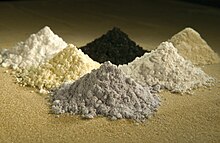 |
| These rare-earth oxides are used as tracers to determine which parts of a drainage basin are eroding. Clockwise from top center: praseodymium,cerium, lanthanum, neodymium,samarium, and gadolinium
Despite their name, rare earth elements (with the exception of the radioactive promethium) are relatively plentiful in the Earth's crust, with cerium being the 25th most abundant element at 68 parts per million (similar to copper). However, because of their geochemical properties, rare earth elements are typically dispersed and not often found concentrated as rare earth minerals in economically exploitable ore deposits. It was the very scarcity of these minerals (previously called "earths") that led to the term "rare earth". The first such mineral discovered was gadolinite, a compound of cerium, yttrium, iron, silicon and other elements. This mineral was extracted from a mine in the village of Ytterby in Sweden; several of the rare earth elements bear names derived from this location.
|


Comments
Post a Comment